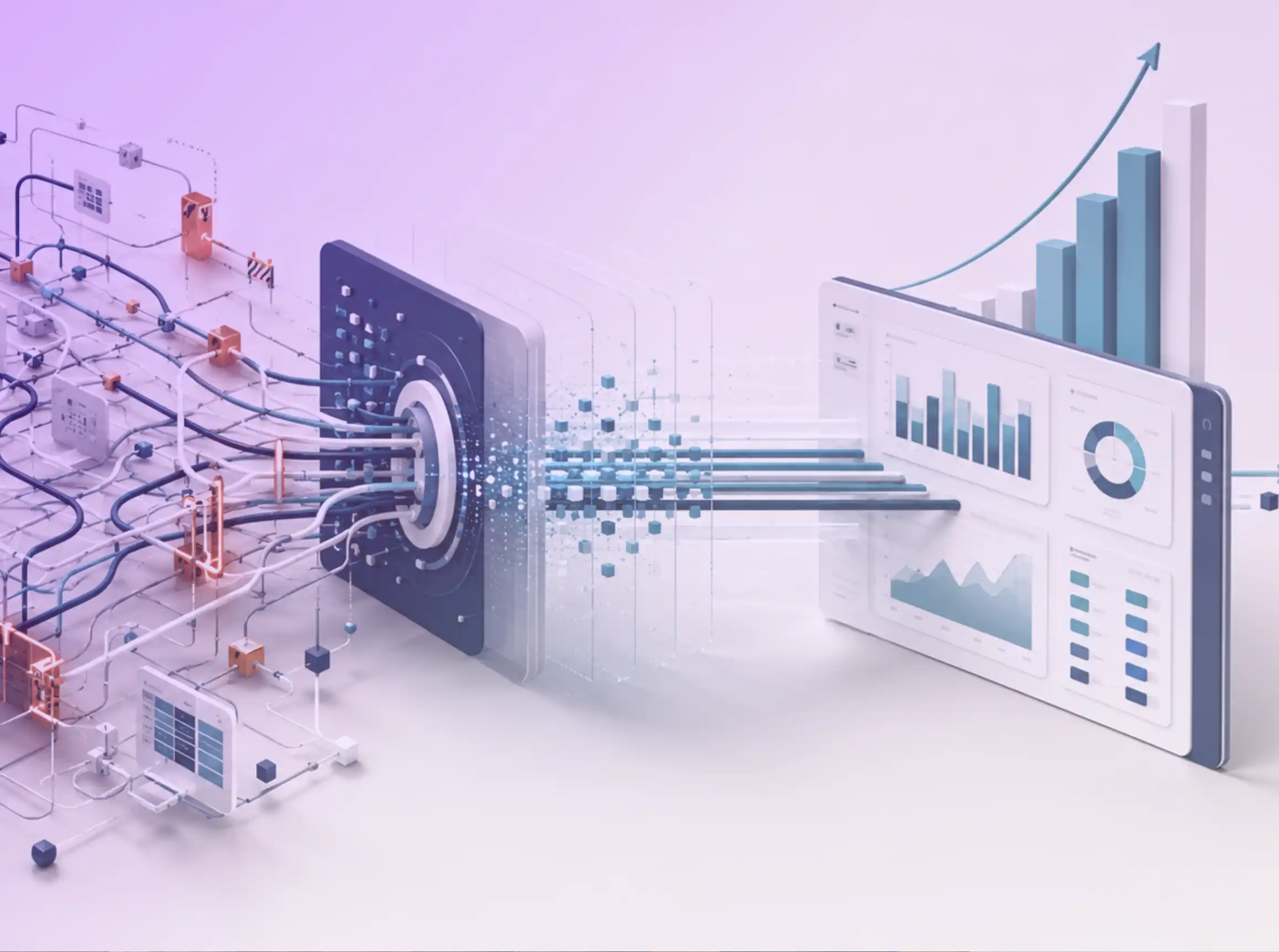
Your Business Doesn't Have a Data Problem. It Has a Decision-Making Problem.
Most organisations already have more information than they can effectively use. The challenge is bringing fragmented data together so leaders can trust what they see, understand what it means and decide what to do next.

Data Everywhere, Clarity Nowhere - why more information doesn't always lead to better decisions
For most organisations, information has never been more readily available.
Sales teams can see opportunities in their CRM. Finance has real-time visibility of cash flow. Operations monitor production, inventory and service delivery. HR systems record workforce metrics, while Microsoft 365 captures an almost continuous stream of communication and collaboration. Every department, it seems, has its own dashboards, reports and key performance indicators.
Yet many leadership teams continue to make important decisions in much the same way they did a decade ago.
Weekly management meetings still begin by reconciling different versions of the same figures. Reports are exported into spreadsheets before anyone feels confident enough to discuss them. Significant time is spent understanding why numbers do not agree, rather than deciding what to do next.
The challenge is rarely a shortage of information.
It is a shortage of confidence in that information.
The problem is seldom a lack of data
When reporting feels slow or inconsistent, the instinctive response is often to invest in another reporting platform or another dashboard.
Occasionally that proves to be the right answer.
More often, it simply introduces another source of information into an already crowded landscape.
As organisations evolve, technology evolves alongside them. New systems are introduced to solve immediate operational challenges. Existing platforms are customised. Departments develop their own reports because they need answers more quickly than central systems can provide. Each decision is entirely rational at the time it is made.
Over several years, however, these individual decisions can produce an organisation where several systems each contain part of the truth, but none provides the whole picture.
The consequence is familiar to many executive teams.
Before discussing performance, people first discuss whose numbers are correct.
That is not a reporting problem.
It is an organisational one.
The hidden cost is uncertainty
Technology expenditure is relatively straightforward to measure. Software licences, implementation projects and support contracts all appear in budgets and financial reports.
The cost of uncertainty rarely does.
Projects pause while information is verified. Operational issues remain unresolved because different departments are working from different assumptions. Customer enquiries require manual investigation when the answers should already exist. Management meetings become exercises in validating data rather than interpreting it.
None of these delays appears especially significant in isolation.
Taken together, they shape how quickly an organisation responds to customers, competitors, market conditions and emerging opportunities.
The issue is not the availability of information.
It is the effort required to trust it.
Better information begins with better questions
Many analytics initiatives begin with technology. Organisations invest in reporting platforms, commission new dashboards or consolidate data into a central warehouse before agreeing what decisions the information is intended to improve.
The sequence is understandable, but it often produces disappointing results.
Reporting becomes more sophisticated without becoming more influential. Executives receive information more quickly, yet continue relying upon experience and judgement because confidence in the underlying data has not materially improved. New dashboards are introduced while older reports continue circulating by email, each serving a different audience and each presenting slightly different interpretations of the business.
The issue is rarely the capability of the technology itself. It is that information has been organised around systems rather than decisions.
The organisations that derive the greatest value from analytics tend to approach the problem from the opposite direction. They begin by identifying where uncertainty is slowing the business. Which decisions consume disproportionate management time? Where do discussions repeatedly focus on reconciling information rather than acting upon it? Which operational questions consistently require manual investigation before anyone feels confident enough to respond?
Viewed through that lens, analytics becomes less about reporting performance and more about reducing organisational friction.
Visibility should simplify the business
Digital transformation has allowed organisations to observe almost every aspect of their operations. Sales activity, customer behaviour, financial performance, production output and workforce information can all be monitored in near real time. The availability of information has improved dramatically.
Clarity has not always kept pace.
Many leadership teams now find themselves navigating an environment in which information is abundant but interpretation remains fragmented. Departments optimise locally because that is where visibility is strongest. Enterprise-wide understanding becomes more difficult precisely because each function has become better informed within its own boundaries.
This is one of the less obvious consequences of digital maturity. The challenge gradually shifts from collecting information to establishing confidence that everyone is interpreting the same business reality.
That is why the most effective organisations invest as much effort in governance, ownership and consistency as they do in technology itself.
Analytics is ultimately about organisational confidence
The commercial value of analytics is often measured through faster reporting or reduced administrative effort. Those outcomes are valuable, but they are not the principal reason mature organisations continue investing in their data.
The greater prize is confidence.
Confidence that operational issues will be identified before they become commercial problems.
Confidence that leadership discussions are based upon a shared understanding of performance rather than competing interpretations.
Confidence that growth, regulatory change or new technologies such as artificial intelligence can be supported by information that is complete, trusted and consistently managed.
Seen in that context, analytics is not simply another technology discipline.
It is part of the infrastructure that allows organisations to make better decisions with greater certainty.
As the volume of business information continues to increase, that confidence is likely to become a more significant competitive advantage than the data itself.
How Kanj helps
Most organisations already possess the information they need to make better decisions. The challenge is bringing that information together in a way that is trusted, accessible and aligned with how the business actually operates.
Kanj helps organisations simplify complex data environments, connect disconnected systems and automate the manual processes that consume valuable management time. Whether the objective is creating a single source of truth, improving operational reporting, reducing repetitive administration or preparing data for AI initiatives, the focus remains the same: giving leadership teams greater confidence in the decisions they make.
Because successful organisations rarely need more data.
They need greater confidence in the information they already have.